Every year on 22 March, World Water Day is celebrated. It was established by the United Nations General Assembly in 1992 at the conclusion of the Rio Conference on Environment and Development, and was officially celebrated for the first time in 1993.
World Water Day was created with the aim of raising awareness of the need to take action to address the global water crisis, one of the great challenges of our time.
Despite the progress made in recent decades, around 2.1 billion people worldwide still live without safe and continuous access to drinking water, with direct consequences for their health and, more generally, for their ability to build a dignified future.
Universal access to safe drinking water and sanitation has been included as a key point in Goal 6 of the 2030 Agenda for Sustainable Development adopted by the United Nations.
In this global scenario and in line with Goal 6 of the 2030 Agenda, in pursuit of its mission to ‘Empower people and communities’, the Andrea Bocelli Foundation has chosen to bring clean water to Haiti, one of the countries most affected by the water crisis.
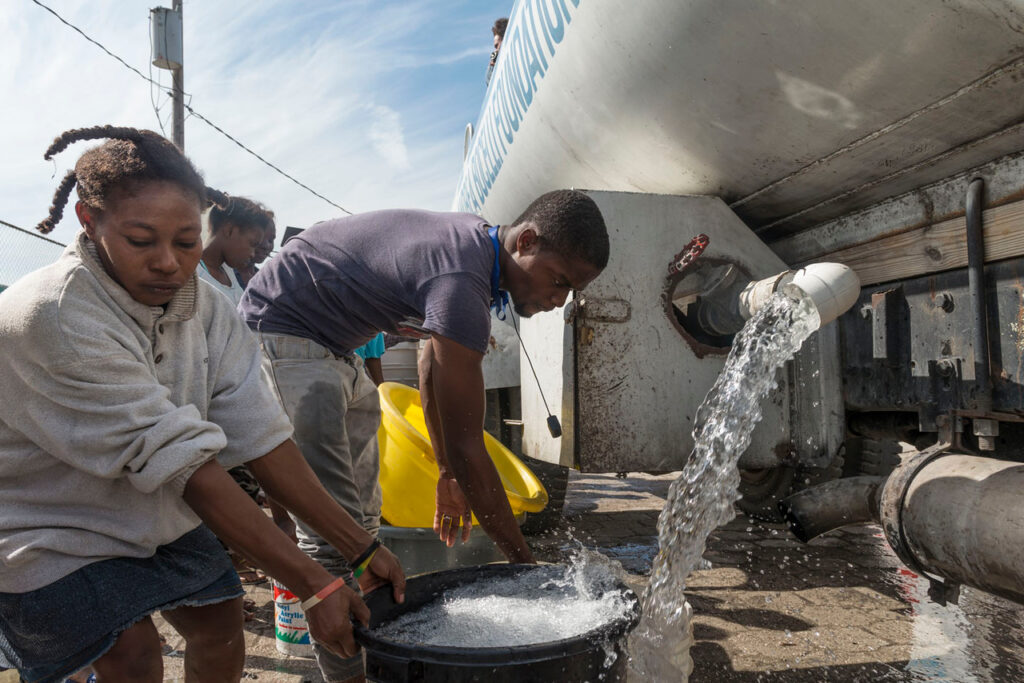
Through the ABF Water Truck project, since 2013 ABF has been supporting two tanker trucks that distribute clean water three times a day, six days a week, to the slum of Cité Soleil, providing 24,000 gallons of water daily to over 400,000 people.
For ABF, talking about World Water Day means promoting awareness, inviting people to view water not only as a natural resource but as a fundamental right, and showing how, through projects in the field, this right can become a reality for communities that still lack it.
What is World Water Day?
World Water Day is an international event celebrated every year on 22 March. It was established by the United Nations General Assembly in 1992 at the conclusion of the Rio Conference on Environment and Development, and was officially celebrated for the first time in 1993.
World Water Day was created to draw global attention to the value of water and the need to ensure safe access to this essential resource for all people, while promoting sustainable water management.
Each year is dedicated to a specific theme related to connected or parallel emergencies (in 2026 it is Water and Gender) and represents an opportunity for awareness-raising, information and mobilisation for governments, institutions, schools, third sector organisations and citizens.
Why was it established?
World Water Day was established to draw global attention to the importance of access to drinking water around the world and the need to protect and sustainably manage the planet’s water resources.
The aim is to raise awareness of issues related to water scarcity, pollution and unequal access, to promote policies and concrete actions to guarantee everyone’s right to drinking water and sanitation, and to remind us that water is an essential resource for life, health, the environment and sustainable development.
Why is it important?
World Water Day is important because it draws attention to a fundamental human right that, even today, is denied to many. According to data provided by the United Nations, over 2.1 billion people worldwide do not have safe access to drinking water and essential sanitation services.
The issue of drinking water is also closely linked to the Sustainable Development Goals of the UN’s 2030 Agenda, in particular SDG 6 (“Clean water and sanitation for all”), bearing in mind that water is essential not only for health, but also for poverty reduction, food security, peace and human rights, ecosystems and education.
In fact, drinking water is linked to issues that are only apparently unrelated. When water is scarce or unsafe, disease and food insecurity increase, inequalities worsen, children stop going to school to fetch water and social tensions rise.
Ensuring clean water and sanitation therefore means taking simultaneous action on quality of life, human rights and the possibilities for sustainable development of entire communities.
World Water Day is a call to action, encouraging governments, institutions, the third sector, businesses and citizens to change policies, behaviours and investment priorities in order to ensure that access to water becomes a reality for everyone, in every country in the world.
What is being done?
On World Water Day, parallel initiatives are developed at various levels. Starting with the official global event coordinated each year by the United Nations, UNESCO and UN-Water.
In 2026, for example, the UNESCO Office in Venice and the WWAP – World Water Assessment Programme are organising a meeting to be held on 23 March 2026 on the theme “Water and Gender – Where Water Flows, Equality Grows”.
This event, which will bring together key stakeholders to promote dialogue, partnerships and concrete actions for more inclusive and resilient water systems, will also see the release of the United Nations World Water Development Report 2026 (WWDR 2026).
Alongside this event, governments, schools, universities, third sector organisations and local communities are promoting conferences, information campaigns and fundraising campaigns for projects related to access to water and the protection of water resources. Organisations such as the Andrea Bocelli Foundation are using the occasion to raise awareness of the right to drinking water and to showcase concrete initiatives, such as the ABF Water Truck project in Haiti, inviting their supporters to turn awareness into active support.