For today’s young people, navigating study paths and career prospects is increasingly complex. On one hand, opportunities are expanding; on the other, the tools needed to interpret them and turn them into informed choices are often lacking.
Some guidance programs focus mainly on educational offerings or available opportunities, leaving in the background a fundamental dimension: self-knowledge—understanding one’s potential and the transversal (soft) skills needed to build a future.
In this context, vocational guidance emerges as a process capable of supporting young people in developing awareness, autonomy, and vision.
In this article, we explore what is meant by vocational guidance, focusing on the programs developed by ABF, particularly through the ABF Globalab initiative.
What Is Vocational Guidance
Vocational guidance refers to a pathway that helps young people recognize their interests, aptitudes, resources, and skills, connecting them with the educational and professional opportunities available to them.
It is not just about choosing a school, university, or job, but about a broader process of self-discovery and personal path-building.
According to ISTAT data reported in the SDGs Report 2023 – Statistical Information for the 2030 Agenda, in Italy 11.5% of young people aged 18 to 24 leave education and training early—still far from the European target of 9% by 2030.
Another significant indicator concerns young people aged 15 to 29 who are not in education, employment, or training (the so-called NEETs), who account for 19% in Italy compared to the European average of 11.7%.
It is also important to consider that in schools, the development of transversal skills is assigned to subject teachers, who are required by current regulations to teach with a dual objective: promoting both subject-specific competencies and soft skills.
However, this—combined with teacher training that focuses more on teaching methods than pedagogy—often makes it difficult to effectively foster and support the development of these transversal skills in students.
Currently, in upper secondary schools, transversal skills development is largely confined to PCTO (Pathways for Transversal Skills and Orientation), aimed at ensuring that students aged 15 to 18 acquire both basic knowledge and job-market-relevant skills.
However, the number of hours allocated remains very limited:
- 90 hours in high schools
- 150 hours in technical institutes
- 210 hours in vocational institutes
In percentage terms, this represents just 3% of total hours in high schools, 5% in technical institutes, and 7% in vocational schools.
Within this context, vocational guidance plays a crucial role in helping young people recognize their abilities, strengthen transversal skills, and develop a more conscious vision of their future.
Objectives
As mentioned, in the sense intended by the Andrea Bocelli Foundation, vocational guidance aims to support young people in developing greater self-awareness, understanding their abilities and opportunities, and making informed, coherent life choices.
It is important to emphasize that this is not only about identifying an educational or professional direction, but about promoting a broader process involving the emergence and strengthening of transversal skills. These are defined by the European Centre for the Development of Vocational Training (CEDEFOP) as a “set of non-technical skills and knowledge that support effective participation not only in life, but also in education and work.”
These skills can be divided into three macro areas:
- The area of knowing
- The area of relating, communicating, and emotions
- The area of coping/managing
The importance of transversal skills in everyday life is also emphasized by the WHO, which refers to them as “life skills”, meaning the set of personal and relational abilities needed to manage relationships with the world and face daily life positively. A lack of these socio-emotional skills can lead, especially among young people, to negative and risky behaviors in response to stress.
This approach is also part of the broader framework of the Sustainable Development Goals (SDGs) of the 2030 Agenda for Sustainable Development, particularly Goal 4 – Quality Education. In this context, Target 4.7 highlights the need to ensure that all learners acquire the knowledge and skills necessary to promote sustainable development.
Vocational guidance supports the achievement of this goal by providing young people with concrete tools to understand themselves, interpret their context, and actively build their own path, developing skills with both individual and social impact.
Approach and Methodology
Within the activities carried out by the Andrea Bocelli Foundation, the ABF Globalab program includes a series of projects aimed at young people aged 16 to 35, focused on vocational, educational, and professional guidance through the acquisition and strengthening of transversal skills.
These pathways are based on an approach that places the individual and their potential at the center, accompanying them in a process of discovery and conscious construction of their path.
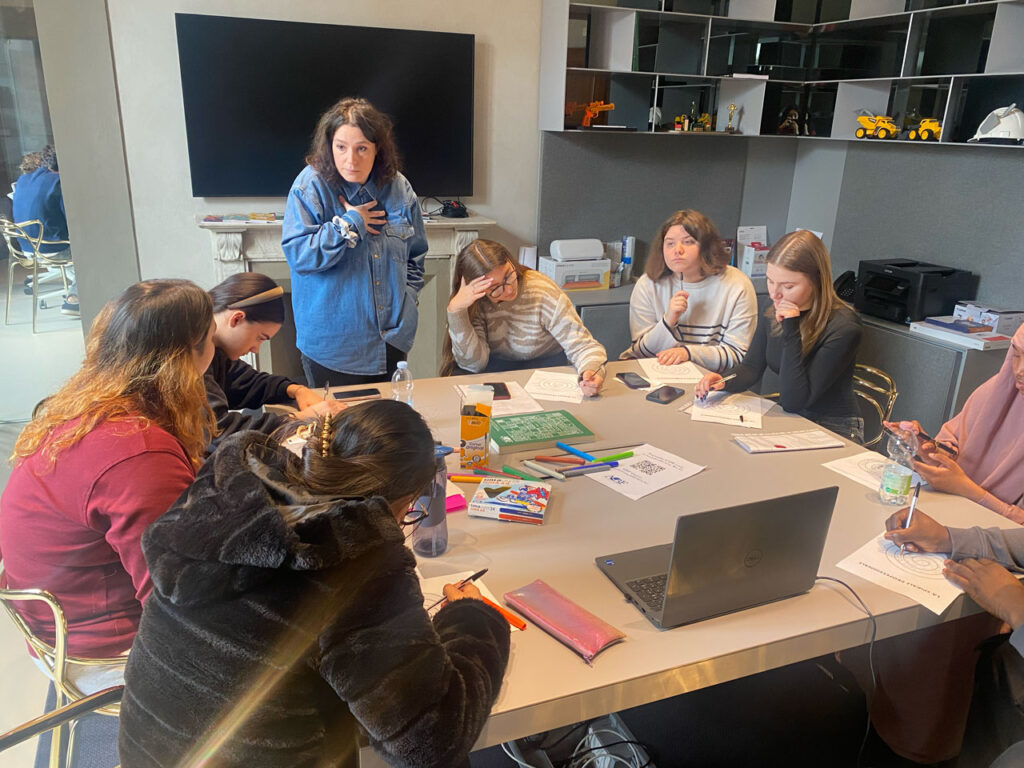
From a methodological perspective, ABF adopts a practical-experiential dimension, where learning is not delivered theoretically but takes shape through direct experience via workshops and labs guided by ABF trainers.
Participants are actively involved in activities that stimulate discussion, collaboration, and self-reflection. A central tool is the concept of “learning by doing”, that is, learning through action, experimentation, and engagement.
The methodology integrates individual work with group dynamics, fostering exchange, constructive feedback, and the development of relational skills. Through collaborative work, problem-solving, and critical and creative thinking, young people are supported in recognizing their resources, developing autonomy, and building a clearer and more conscious vision of their future.
In this way, guidance becomes an active growth process in which each individual can explore, understand, and shape their life project.
Target Audience
The ABF Globalab vocational guidance program is aimed at young people aged 16 to 35.
The projects can be divided into two macro-categories:
- Workshop-based pathways integrated into the school curriculum, valid as PCTO (Pathways for Transversal Skills and Orientation), aimed at young people aged 16 to 19
- Workshop-based pathways for basic and continuing education aimed at the 18–35 age group
A third category consists of informational and participatory design pathways aimed at upper secondary school teachers, focusing on enhancing transversal skills and transferring technological innovation.
ABF Initiatives
Within the ABF Globalab program, there is a variety of vocational, educational, and professional guidance projects aimed at strengthening transversal skills and proactive engagement.
ABF WANNABE is a guidance pathway within the PCTO framework, developed through participatory design with teachers and guidance professionals from the Florence area. It involves high school students and alternates plenary sessions with experts and workshops focused on conflict and positive resolution strategies.
ABF Talent4You, also within PCTO, is aimed at students in their final years of high school. It offers practical-experiential workshops to develop socio-relational, communication, emotional, digital, organizational, and “visioning” skills. It supports participants in developing a project idea through to its final presentation, concluding with a themed experiential trip.
ABF Vocational is a short orientation and activation pathway aimed at young people in a phase of transition or redefinition of their path, developed in collaboration with training agencies and local educational organizations.
ABF Talent4Work is aimed at young people experiencing challenges in the school-to-work transition, enhancing their personal background, exploring professional opportunities, and providing practical tools and mentoring.
ùWithin ABF Globalab, there are also Advanced Training Masterclasses for young artists and professionals in fields such as creative writing, opera singing, and chamber music, allowing them to deepen both technical and transversal skills.
Finally, the San Firenze Committee acts as a connecting thread linking all ABF Globalab projects. It involves participants who have completed one of the programs and choose to remain active within the Foundation, becoming a space for ongoing youth participation and active citizenship.