Music education is a powerful tool for fostering the growth of children and young people. Through music, it is possible to develop cognitive, relational, and emotional skills that are fundamental to an individual’s overall development.
Music—and the arts more broadly—have an internationally recognized educational value. They help promote transferable skills, inclusion, well-being, and human development.
Numerous pedagogical and neuroscientific studies highlight how learning music enhances listening skills, concentration, creativity, and the ability to collaborate with others, contributing to the harmonious development of individuals and the communities in which they live.
For these reasons, music is increasingly present in educational settings, from schools to cultural and social projects. It is becoming a universal language capable of bringing people and communities together and creating shared opportunities for growth.
In this article, we will explore what is meant by music education and why it is important for the development of both children and adults.
We will also look at some examples of music education, focusing in particular on the approach of the Andrea Bocelli Foundation and its ABF Voices Of program, which uses music as a tool for empowerment and participation for young people from vulnerable contexts around the world.
What is meant by music education
Music education refers to a set of educational practices that use music as a tool for learning, expression, and personal development. It is important to emphasize that it is not just about teaching how to play an instrument or read sheet music, but about guiding children and young people in discovering the language of music through listening, rhythm, singing, and group practice.
According to the UNESCO Framework for Culture and Arts Education, culture and the arts (including music) are an integral part of inclusive, equitable, and quality education. By promoting creativity, critical thinking, and respect for cultural diversity, they enable students to engage meaningfully with the world and contribute to building more just, sustainable, and peaceful societies.
The guidelines for implementing the UNESCO Framework represent a collective call to rethink education by placing culture and the arts at its center and promoting a transformative vision of education for all.
This international framework and approach should always be taken into account when discussing music education.
In the field of pedagogy, music education is considered a discipline that contributes to the holistic development of the individual by simultaneously stimulating cognitive, emotional, and relational dimensions.
Another key element of music education is its experiential and participatory nature. For example, singing or playing together allows children and adults to experience the value of collaboration and creativity firsthand.
Finally, music is a universal language capable of overcoming linguistic and cultural barriers. This is why it is increasingly used in educational contexts as a tool to foster inclusion, dialogue, and active participation within communities.
Why it is important for children’s development
According to the National Guidelines for the curriculum of preschool and primary education issued by the Italian Ministry of Education and Merit (MIM), the study of music is essential for understanding a priceless part of our cultural identity, through which Italy is known worldwide.
According to these guidelines, music is a discipline capable of promoting various interdependent educational functions:
- Cognitive-cultural function: symbolic representation of reality, development of thinking skills, and participation in musical cultural heritage. Music also stimulates attention, memory, and concentration.
- Critical-aesthetic function: refinement of aesthetic taste, independent judgment, artistic sensitivity, and the ability to interpret, evaluate, and make informed musical choices.
- Linguistic-communicative function: the ability to communicate and express oneself through the language of music.
- Emotional-affective function: development of emotional skills, providing a safe space to express and recognize emotions.
- Relational-social function: managing relationships with others. Group musical activities help children and young people develop mutual listening, collaboration, and respect for others’ timing and space.
- Identity and intercultural function: development of one’s cultural identity and respect for other cultures and traditions.
- Kinesthetic-corporeal function: internalization of music, kinesthetic sensitivity, sensorimotor coordination, and abstract thinking.
Music education also helps prevent social discomfort and school dropout, encourages respect for rules, and promotes cooperation—especially in choral and ensemble contexts.
Last but not least, music education is a powerful stimulus for creativity and imagination, as it encourages children to experiment and improvise, fostering creative thinking and the exploration of new forms of expression.
It is precisely because of these considerations that ABF has made the languages of music—alongside art and new digital technologies—the foundation of its educational projects.
Some examples of music education
Music education can take many different forms depending on the educational context, the age of the children, and the learning objectives.
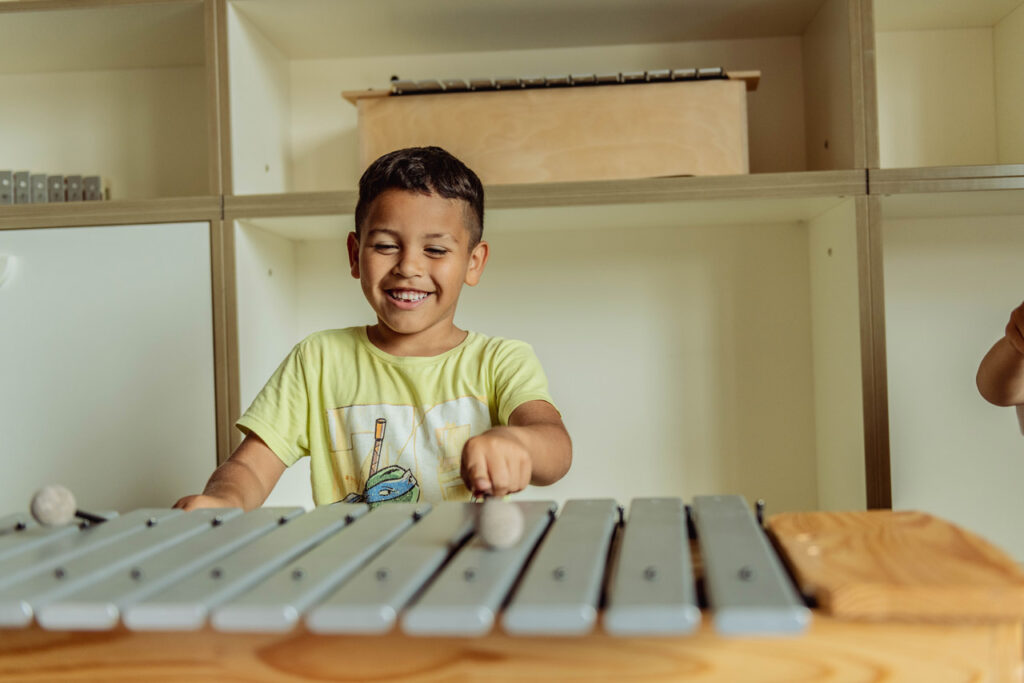
Among the most common examples is learning to play a musical instrument. There are also activities based on guided listening, aimed at helping children develop musical sensitivity and interpretative skills, as well as musical games based on rhythm, body, and movement, through which music can be experienced in a spontaneous and engaging way.
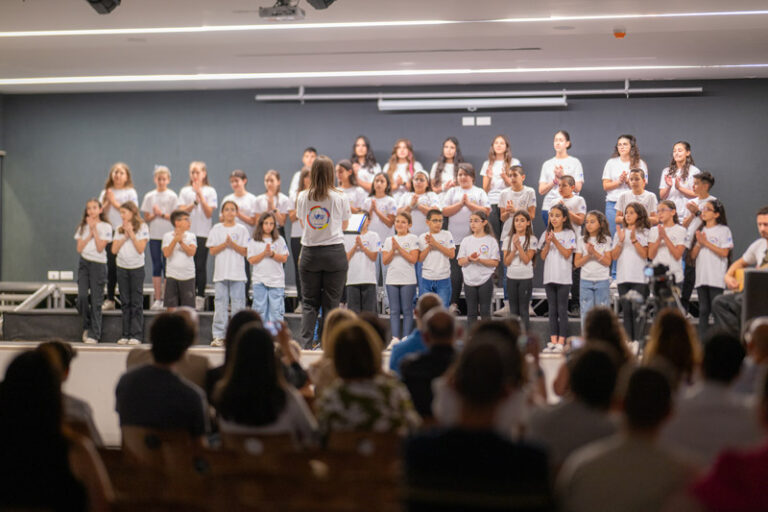
Another widely practiced form of music education is choral singing. Singing in a choir—and making music together—is a lesson that goes far beyond music itself. Through this practice, children learn not only to coordinate their voices with others but also to listen to their peers and respect timing and harmony.
For this reason, choral singing is highly effective in developing collaboration skills. It is precisely due to the power of the choir as a tool for individual and collective development that the Andrea Bocelli Foundation created the ABF Voices Of program—an educational path inspired by the transformative and generative power of music.
In this context, music becomes a tool for empowerment for individuals and communities living in vulnerable countries. Alongside the ABF Voices of Italy choirs in Naples and Camerino, the Foundation has launched the project in Haiti, the Holy Land, and Uganda, with the aim of supporting the emergence and enhancement of talent and the development of socio-emotional skills in these critical contexts.
The ABF approach
In pursuing its mission of “Empowering people and communities,” ABF promotes educational projects in which music becomes a tool for personal and collective empowerment. It goes beyond technical learning, becoming an experience that engages the whole person and fosters emotional and social development.
This is exactly what happens in the ABF Voices Of program. Through the creation of regional choirs, children and young people have the opportunity to experience music as a collective form of expression and collaboration, while also discovering the value of teamwork, intercultural dialogue, and a sense of belonging to both local and international communities.
Within the ABF Art, Music & Digital Labs project—developed in pediatric hospitals and schools in Central Italy rebuilt by the Foundation after the 2016 earthquake—the Andrea Bocelli Foundation has also introduced the role of the atelierista.
Specifically, the ABF music atelierista is a professional musician who guides children and young people through educational paths based on an experiential and participatory approach.
The Foundation’s commitment to music education also inspired the reconstruction of the “Franco Corelli” Music Academy in Camerino, restored to the community after the earthquake that struck Central Italy in 2016.
Today, the Academy represents a center for education and advanced musical training, where young international talents can pursue high-level specialization and artistic growth, while also contributing to the cultural revival of the region.