On August 24, 2016, at 03:36:32, a powerful magnitude 6.0 earthquake struck Central Italy, triggering a seismic sequence that—together with subsequent events in October—deeply impacted the lives of entire areas across Lazio, Marche, Umbria, and Abruzzo.
Ten years later, the memory of those moments is still vivid, and the long process of reconstruction is still ongoing. The Andrea Bocelli Foundation chose to play an active role in this process, focusing its efforts on the Marche region and working alongside local communities and the Extraordinary Commissioner for Reconstruction, starting from places of education.
In this article, we will revisit what happened in 2016, identify the most affected areas, and examine the damage caused by the seismic swarm. We will also analyze the situation ten years later, highlighting the reconstruction projects carried out by the Foundation in the field of education.
What happened
Between 2016 and early 2017, the central Apennines were affected by a long series of earthquakes, defined by the INGV (National Institute of Geophysics and Volcanology) as the “Amatrice–Norcia–Visso seismic sequence,” based on the location of the main epicenters. The key moments of the seismic swarm can be summarized as follows:
- On August 24, 2016, at 3:36 a.m., a first major earthquake of magnitude 6.0 struck the area between Accumoli (RI) and Arquata del Tronto (AP);
- On October 26, 2016, two new strong shocks of magnitude 5.4 and 5.9 hit the same Apennine area, with epicenters between Castelsantangelo sul Nera, Visso, and Ussita, on the border between Marche and Umbria;
- On October 30, 2016, the strongest shock of the entire sequence occurred, with a magnitude of 6.5 and an epicenter between Norcia and Preci, in the province of Perugia;
- On January 18, 2017, four additional shocks, all between magnitude 5 and 5.5, struck the area between Montereale, Capitignano, Pizzoli, and Cagnano Amiterno (AQ).
Overall, this sequence of seismic events—second only to the 1980 Irpinia earthquake in terms of violence and destruction—caused around 300 deaths, more than 400 injuries, 41,000 displaced people, and devastated an area of approximately 8,000 km², wiping out entire villages and a unique historical and artistic heritage.
Which areas were affected
As mentioned, the 2016–2017 seismic swarm extensively affected the central Apennines. Four regions—Lazio, Abruzzo, Marche, and Umbria—were the most involved, with a total of 138 municipalities included in what reconstruction laws and ordinances define as the “seismic crater.”
According to the May 2024 Reconstruction Report by the Extraordinary Commissioner, the most severely affected municipalities—identified to accelerate private reconstruction programs—are 44 in total: 29 in Marche, 6 in Abruzzo, 6 in Lazio, and 3 in Umbria.
These are mainly small towns with fewer than one thousand inhabitants, already affected by depopulation—a trend that the 2016–2017 earthquakes significantly worsened.
Marche is therefore the most impacted region, both in terms of the number of municipalities within the seismic crater and the extent of damage to public (schools, municipal buildings, healthcare and cultural facilities) and private buildings.
It is precisely in this region that the Andrea Bocelli Foundation decided to intervene immediately—and to remain—through its urban regeneration projects.
Damage caused by the seismic sequence
As noted, the earthquake caused around 300 deaths, more than 400 injuries, and 41,000 displaced people, affecting an area of about 8,000 km².
In total, approximately 320,000 buildings were damaged across more than 130 municipalities, affecting a population of around 600,000 residents.
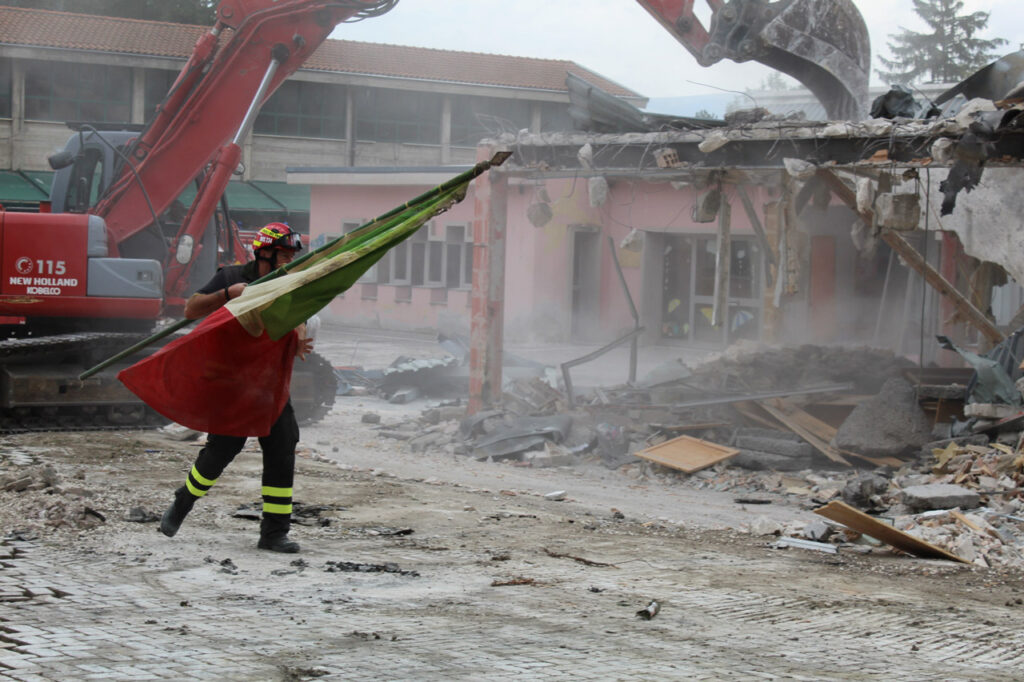
The impact was particularly devastating in historic villages, where collapses, widespread structural damage, and unusable buildings made entire parts of towns inaccessible. This had profound effects on daily life, economic activities, and social cohesion.
This impact is even more significant when buildings such as schools, churches, and community spaces—key to local identity—are affected.
It is within this context that ABF’s reconstruction projects in the province of Macerata, the area most affected by the earthquake, take place.
The situation 10 years later
Ten years after the first shocks, the situation in Central Italy has improved compared to the immediate aftermath, although reconstruction is still ongoing.
According to the 2025 Reconstruction Report by the Extraordinary Commissioner, Central Italy is described as “the largest construction site in Europe,” where not only buildings are being rebuilt, but also the living conditions of affected communities.
In terms of housing, significant progress has been made in recent years. In 2025 alone, 1,115 families returned to their homes, and since 2022, more than 4,000 households have regained stable housing.
However, around 10,000 families (over 20,000 people) are still living in temporary solutions while waiting for permanent housing.
Private reconstruction has accelerated over the past three years. As of May 31, 2025, 34,148 applications for housing damage contributions had been submitted, with a total value exceeding €15.8 billion. Of these, 12,737 projects have been completed, 8,694 are ongoing, while the remaining applications are in the planning phase or awaiting approval.
Most applications come from Marche, with 19,315 requests totaling nearly €10.5 billion, followed by Abruzzo, Umbria, and Lazio.
Public reconstruction—including schools, municipal buildings, infrastructure, and public-use facilities—also shows clear progress. As of May 31, 2025, there are 3,542 projects worth over €4.6 billion, and for about 98% of them, a project manager has already been appointed.
ABF’s intervention in the affected areas
Within the vision of the Andrea Bocelli Foundation, education is the starting point for change and the foundation upon which the future of individuals and communities is built.
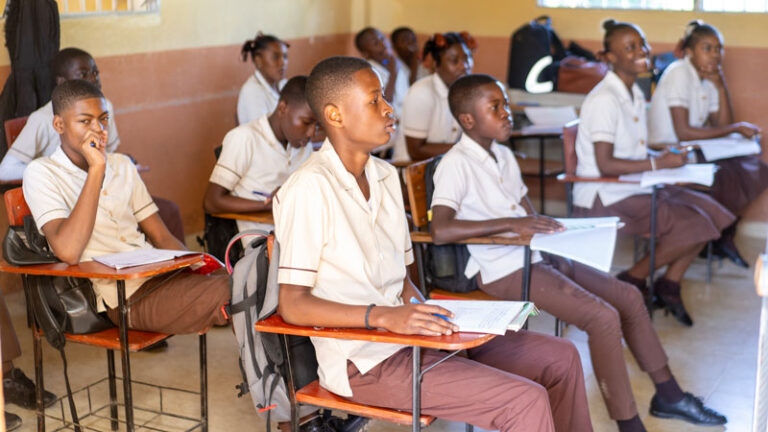
This is why most of the Foundation’s initiatives revolve around educational projects—and why ABF chose to actively intervene in the areas most affected by the earthquake, starting with schools as symbols of rebirth and hope.
Five key interventions—part of the broader ABF Edu program—have already been completed in collaboration with local municipalities:
- the “Giacomo Leopardi” middle school in Sarnano;
- the “E. De Amicis” primary and kindergarten school in Muccia;
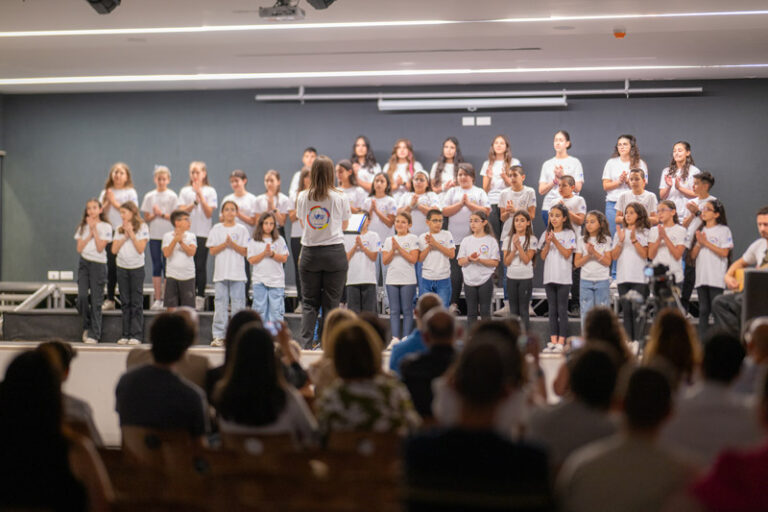
- the ABF “F. Corelli” Music Academy in Camerino;
- the ABF Educational Hub 0–11 in Sforzacosta;
- and the “Ugo Betti” Institute in Camerino (where ABF contributed to educational setups and creative ateliers).
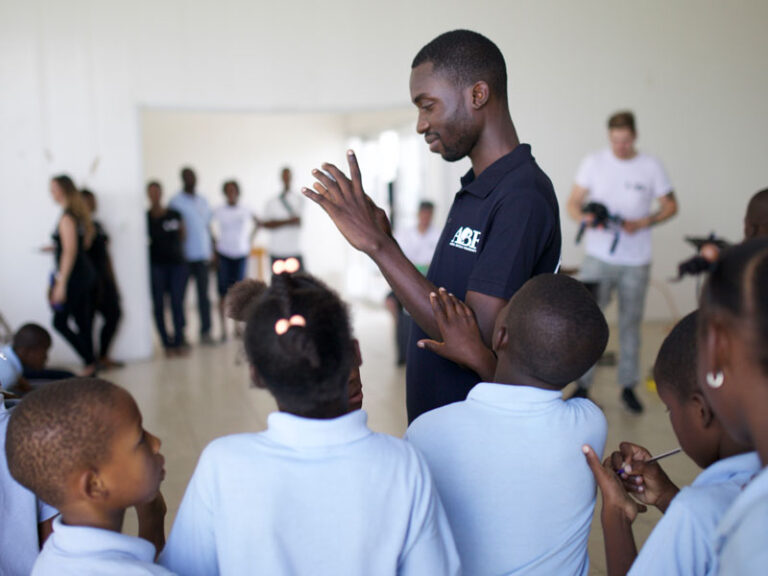
“Being there to stay” is the guiding principle behind ABF’s work in the earthquake crater. This approach also led to the launch of the ABF Digital Lab project within the rebuilt schools, aimed at fostering learning environments that promote interaction, communication, and relationships through new technologies—helping every child discover and develop their talents.
ABF Digital Lab includes the donation of the ABF Teachbus, a mobile digital library equipped with tablets, computers for distance learning, virtual reality headsets, and access to the “ABF Educational” platform, which offers a wide range of educational content.
It also introduces the role of the Digital Atelierista, an education professional who supports teachers and students in using the digital tools and resources provided by the Foundation.
ABF’s intervention goes beyond rebuilding school buildings: it also promotes innovative educational environments, transforming schools into true community hubs.
Looking ahead, the new IPSIA “R. Frau” in San Ginesio will be returned to the community in September 2026. This school will serve as a strategic educational center for technical and vocational training for new generations.
This project represents a national pilot initiative due to its innovative approach, combining public and private collaboration through co-programming, co-design, and co-implementation.
On behalf of the Reconstruction Commissioner, the Andrea Bocelli Foundation acts as both designer and project manager, working through a multidisciplinary team in close collaboration with the commissioner’s offices, the Municipality of San Ginesio, and the school.
From the early stages, a participatory design process has been developed with the school, involving teachers through dedicated meetings and site visits—a dialogue that continues today in shaping the educational spaces and facilities.